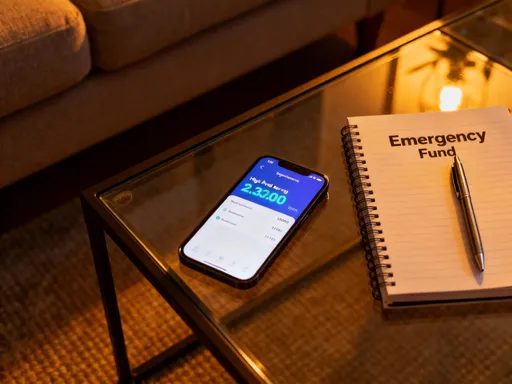
What If Your Emergency Fund Could Grow Instead of Just Sitting There?
You’ve probably heard it a million times: “Build an emergency fund.” But what if that money didn’t just sit in a lifeless account? What if it could quietly work for you—earning returns without risking your safety net? I’ve been there, staring at my savings, wondering why they weren’t doing more. This guide shares how to keep your emergency fund secure and let it grow, using real strategies that balance safety, access, and smart growth—without crossing into risky territory. It’s not about chasing high returns or gambling with your safety net. It’s about making thoughtful, informed choices so your money stays protected while still gaining ground against inflation and time. The goal is simple: turn your emergency fund from a static cushion into a dynamic part of your financial life.
The Hidden Truth About Emergency Funds No One Talks About
Most people treat their emergency fund like a fire extinguisher—something you buy, store away, and hope never to use. It sits quietly in the corner of your financial life, often in a traditional savings account with a barely noticeable interest rate. While this approach feels safe, it overlooks a subtle but significant threat: inflation. Over time, inflation erodes the purchasing power of money, meaning that $10,000 saved today might only cover $9,000 worth of expenses five years from now. This doesn’t mean your emergency fund has lost value in dollar terms, but in real-world buying power, it has quietly diminished.
Consider a family who built a $15,000 emergency fund during a stable period. They felt secure, knowing they had several months of living expenses covered. But over the next three years, unexpected price increases in groceries, utilities, and medical care meant that their original buffer no longer stretched as far. What once covered four months of essential costs now covered closer to three. The fund hadn’t shrunk in size, but its effectiveness had. This is the hidden cost of keeping emergency savings completely idle—protection without preservation.
The truth is, true financial safety isn’t just about avoiding loss; it’s about maintaining value. An emergency fund should not only protect you from sudden setbacks—like a car repair or medical bill—but also preserve its ability to meet future needs. When inflation runs at 2% to 3% annually, even a “safe” account earning 0.01% interest is effectively losing ground. This doesn’t mean you should take on risk, but it does mean rethinking what “safe” really means. Safety isn’t just the absence of volatility—it’s the presence of stability and gradual growth. By accepting a minimal level of thoughtful strategy, you can shield your fund from both emergencies and silent erosion.
This shift in perspective doesn’t require complex investing. It starts with recognizing that your emergency money doesn’t have to be frozen in place. With the right tools and mindset, it can remain secure while also earning modest returns. The goal isn’t to turn your emergency fund into a wealth-building engine—that’s what retirement or investment accounts are for. Instead, it’s about ensuring that when you do need to use it, it still holds the same real-world value it did when you saved it. In this way, your emergency fund becomes more than just a backup plan; it becomes a resilient, living part of your financial foundation.
Safety First: What Your Emergency Fund Must Never Risk
Before exploring ways to grow your emergency fund, one principle must be clear: the primary role of this money is protection, not profit. This means that no growth strategy is worth pursuing if it jeopardizes access or exposes your savings to loss. The core characteristics of an emergency fund are non-negotiable: liquidity, capital preservation, and immediate availability. Liquidity ensures you can access the money quickly—within days, if not hours. Capital preservation means the value of your principal should not fluctuate with market conditions. Immediate availability means no penalties, waiting periods, or complex redemption processes when you need the funds most.
Some people, eager to boost returns, consider placing emergency savings in stocks, cryptocurrency, or speculative bonds. While these assets may offer higher long-term gains, they are entirely unsuitable for emergency reserves. A stock portfolio can lose 20% or more in a single month during market downturns. Cryptocurrencies are known for extreme volatility, with values swinging dramatically in hours. Even certain types of bonds can be subject to interest rate risk or credit risk, making them unpredictable over short timeframes. If you face a sudden job loss or urgent repair and your emergency fund is tied up in a plunging asset, you’re forced to sell at a loss—defeating the entire purpose of having a safety net.
Real-world examples highlight the danger of misallocating emergency funds. One woman invested her $12,000 reserve in a high-yield bond fund promoted online. When her child required unexpected surgery six months later, she discovered that withdrawing the full amount would trigger a 30-day settlement period and a 2% early withdrawal fee. By the time she accessed the money, she had accumulated medical penalties and stress that could have been avoided. Another individual kept emergency savings in a cryptocurrency wallet, believing it was “digital gold.” When his car broke down, he found that converting his holdings to usable cash took two business days and involved multiple verification steps—time he didn’t have.
These stories underscore a critical rule: emergency funds must be insulated from market risk and operational delays. The modest returns offered by safer options are not a drawback—they are a feature. They reflect stability and predictability, which are far more valuable when dealing with uncertainty. The peace of mind that comes from knowing your money is safe, accessible, and stable outweighs any potential gain from riskier alternatives. This doesn’t mean your fund can’t grow—it means that growth must happen within strict boundaries. The right approach balances cautious optimism with disciplined realism, ensuring that your emergency savings remain exactly what they were designed to be: a reliable lifeline when life takes an unexpected turn.
Where to Park Your Emergency Cash: Beyond the Basic Savings Account
For decades, the standard advice has been to keep emergency funds in a basic savings account at a local bank. These accounts are insured by the Federal Deposit Insurance Corporation (FDIC) up to $250,000 per depositor, per institution, making them a safe choice. However, many traditional banks offer interest rates near zero—sometimes as low as 0.01%. While your money is protected, it’s not keeping pace with inflation. The good news is that there are better options available that maintain safety while offering higher returns. These include high-yield savings accounts, money market accounts, and short-term certificates of deposit (CDs).
High-yield savings accounts are one of the most accessible upgrades. Offered by online banks and credit unions, they typically provide interest rates that are significantly higher than traditional savings accounts—often between 3% and 5% annually, depending on the financial environment. These accounts are still FDIC-insured, meaning your deposits are protected. They also allow for easy transfers and withdrawals, usually with no penalties. Because online banks have lower overhead costs, they can pass the savings on to customers in the form of better rates. For someone with a $10,000 emergency fund, moving from a 0.01% account to a 4% high-yield account could mean earning $400 per year instead of $1—without increasing risk.
Money market accounts (MMAs) are another strong option. These are offered by banks and credit unions and often come with check-writing privileges or a debit card, making access even easier. Like high-yield savings accounts, they are FDIC-insured and designed for stability. Interest rates on MMAs are typically competitive with high-yield savings, though they may require a higher minimum balance to avoid fees or earn the best rate. Some money market accounts also limit the number of withdrawals per month under federal Regulation D, although many institutions have relaxed these rules in recent years.
Short-term certificates of deposit (CDs) offer a slightly different structure. When you open a CD, you agree to keep your money deposited for a fixed period—ranging from three months to two years—in exchange for a guaranteed interest rate. Early withdrawal usually comes with a penalty, so CDs are best used for the portion of your emergency fund you’re less likely to need immediately. One effective strategy is to ladder CDs—opening multiple CDs with different maturity dates—so that funds become available periodically without penalty. For example, you might place one-third of your fund in a 6-month CD, one-third in a 12-month CD, and one-third in an 18-month CD. As each matures, you can renew it or keep the cash available.
These options are not speculative or complex. They are widely available, regulated, and designed for conservative savers. By moving beyond the basic savings account, you can earn meaningful interest without compromising safety. The key is to match the vehicle to your needs: if you need instant access, a high-yield savings account may be best; if you want slightly higher returns and can wait a few months, a short-term CD could be appropriate. The goal is not to maximize returns at all costs, but to optimize for safety, access, and modest growth—all at once.
The Growth Mindset: How Small Gains Add Up Without Big Risks
Many people dismiss modest interest rates as insignificant, especially when compared to the double-digit returns sometimes seen in the stock market. But when applied to a meaningful emergency balance, even small gains can have a real impact over time. Consider a family with a $20,000 emergency fund. If that money sits in a traditional savings account earning 0.01% interest, it will generate about $2 per year. After five years, the total interest earned is barely enough to cover a tank of gas. But if the same amount is placed in a high-yield savings account earning 4%, it earns $800 in the first year alone. With compounding, that number grows further—reaching over $4,000 in interest over ten years, assuming rates remain stable.
This isn’t about getting rich. It’s about reinforcing your financial resilience. That extra $4,000 could cover an additional month of mortgage payments, replace a broken appliance, or help bridge a temporary income gap. It means your emergency fund isn’t just maintaining its value—it’s expanding it. Over time, this creates a psychological benefit as well: seeing your safety net grow, even slightly, reinforces good financial habits and builds confidence. You begin to view saving not as a sacrifice, but as a quiet, steady form of progress.
The power of compounding works best when time and consistency are on your side. Even if you only earn 3% to 5% annually, the effect becomes more pronounced the longer your money stays put. For example, someone who builds their emergency fund gradually over two years will benefit from compound interest on each deposit as it accumulates. Automating transfers to a high-yield account ensures that every dollar starts earning immediately. This approach transforms emergency savings from a static goal into an ongoing process—one where your money works for you even while you sleep.
It’s also important to recognize that inflation is a constant opponent. If prices rise by 2.5% per year and your savings earn only 0.5%, you’re effectively losing 2% of purchasing power annually. But if your savings earn 4%, you’re gaining 1.5% in real terms. That difference may seem small each year, but over a decade, it translates into hundreds or even thousands of dollars in additional buying power. This is the essence of financial preservation: not just protecting your money, but ensuring it retains its ability to meet future needs.
Adopting a growth mindset doesn’t mean taking on risk. It means making intentional choices that align with your long-term stability. It’s about recognizing that safety and growth aren’t opposites—they can coexist when approached with care. By choosing the right account and staying consistent, you can turn your emergency fund into a quiet achiever: always ready to protect you, but also quietly building strength for the future.
Timing and Access: Keeping Your Money Ready When Life Knocks
No matter how attractive the interest rate, a financial vehicle is useless for emergency savings if you can’t access the money when you need it. This is why timing and access are just as important as yield. Some accounts advertise high returns but come with hidden restrictions—such as withdrawal limits, processing delays, or penalties for early access. These features may be acceptable for long-term savings, but they can create serious problems when dealing with urgent needs.
For example, some high-yield savings accounts limit the number of outgoing transfers per month to six, in accordance with federal Regulation D. While many banks no longer enforce penalties for exceeding this limit, the rule still exists and can cause confusion during emergencies. If you need to make a seventh transfer in a month—say, to cover a second unexpected expense—you might face delays or account warnings. Similarly, some money market accounts require a minimum notice period for large withdrawals, or impose fees if you drop below a certain balance. These conditions can undermine the reliability of your emergency fund when you need it most.
Transfer speed is another critical factor. While most online banks allow transfers to linked accounts, the process can take one to three business days. For someone facing an urgent car repair or medical bill, even a 48-hour delay can be stressful. To address this, some savers keep a portion of their emergency fund in a checking account with their primary bank, where funds are immediately available, while the rest remains in a high-yield account earning interest. This hybrid approach balances growth and accessibility.
Certificates of deposit introduce another timing challenge. While they offer fixed rates, they also lock up your money for a set period. Withdrawing early typically triggers a penalty—often equal to several months of interest. This makes CDs better suited for the “later layer” of your emergency fund—the portion you’re less likely to need immediately. To maintain flexibility, you can use a CD ladder strategy, as mentioned earlier, so that a portion of your funds matures regularly. This way, you always have some money becoming available without penalty.
The goal is to structure your emergency savings so that access is predictable, fast, and penalty-free when needed. This might mean accepting a slightly lower rate on a portion of your fund in exchange for better access. It’s a trade-off worth making. After all, the purpose of an emergency fund is not to earn the highest possible return, but to provide peace of mind and financial stability when life becomes unpredictable. By carefully evaluating the access terms of any savings vehicle, you ensure that your money remains not just safe, but truly usable—exactly when you need it most.
Real Moves: Structuring a Smart Emergency Fund in Practice
Building a smart emergency fund isn’t about finding a single perfect account—it’s about designing a system that balances safety, growth, and access. The first step is determining how much you need. Most financial advisors recommend saving three to six months’ worth of essential living expenses. For a household spending $4,000 per month on necessities like housing, food, utilities, and insurance, that means an emergency fund of $12,000 to $24,000. The exact amount depends on your job stability, health, and family situation. If your income is variable or you’re the sole earner, aiming for the higher end makes sense.
Once you’ve set your target, divide your fund into tiers based on access needs. The first tier—your “immediate access” layer—should cover one to two months of expenses and be kept in a high-yield savings account or money market account with no withdrawal restrictions. This money is for true emergencies: a sudden medical bill, a broken furnace, or an urgent car repair. It must be available within 24 to 48 hours, with no penalties.
The second tier—the “growth layer”—can include funds you’re less likely to need right away. This portion can be placed in short-term CDs or longer-term money market funds that offer slightly higher interest rates. Because these accounts may have limited access or early withdrawal penalties, they’re best used for the part of your fund that serves as a backup to the backup. By staggering maturities through a CD ladder, you ensure that a portion of this layer becomes liquid every few months, maintaining flexibility.
Automation is key to maintaining consistency. Set up recurring transfers from your checking account to your emergency savings as soon as you’re paid. Even $200 per month adds up to $2,400 in a year. Treat these transfers as non-negotiable, like a utility bill. Over time, your fund grows without requiring constant attention. Review your emergency fund annually—adjusting for changes in expenses, income, or life circumstances. If you use part of the fund, create a plan to replenish it as quickly as possible.
This tiered, automated approach turns emergency savings from a one-time goal into a sustainable habit. It respects both the need for safety and the opportunity for modest growth. More importantly, it removes emotion from the process. When life gets busy or unexpected expenses arise, your system continues to work in the background, ensuring your financial foundation remains strong.
Beyond the Fund: How This Shift Changes Your Whole Financial Game
Optimizing your emergency fund for both safety and growth might seem like a small change, but its impact extends far beyond the balance in your account. It represents a shift in financial mindset—from passive saving to active stewardship. When you see your emergency money earning interest and maintaining its value, you begin to view your entire financial life with greater intention. This isn’t about chasing quick wins or taking reckless risks. It’s about making thoughtful, consistent choices that build long-term security.
That sense of control can ripple into other areas of your finances. You may become more diligent about budgeting, more confident in managing debt, or more motivated to build additional savings for goals like home ownership or education. When your emergency fund grows steadily, it reinforces the belief that small actions lead to real results. This confidence is especially valuable for women managing household finances, who often bear the emotional and logistical burden of financial planning. Knowing that your safety net is not only secure but also resilient can reduce anxiety and increase decision-making clarity.
Moreover, this approach fosters financial discipline. By automating savings, monitoring access, and reviewing your strategy regularly, you develop habits that support lifelong financial health. You learn to balance caution with opportunity, security with progress. These skills don’t just protect you during crises—they empower you during calm periods, helping you make smarter choices about spending, saving, and investing.
Ultimately, a well-structured emergency fund is more than a financial tool. It’s a statement of self-reliance and foresight. It says that you are prepared, not just for the worst, but for a future where your money works as hard as you do. By choosing stability over speculation and consistency over shortcuts, you build a foundation that can withstand both economic shifts and personal challenges. True financial strength isn’t measured by how much you earn, but by how well you protect and preserve what you have. And when your emergency fund quietly grows while staying completely safe, you’ve found the sweet spot: being prudent, prepared, and just a little bit clever.